
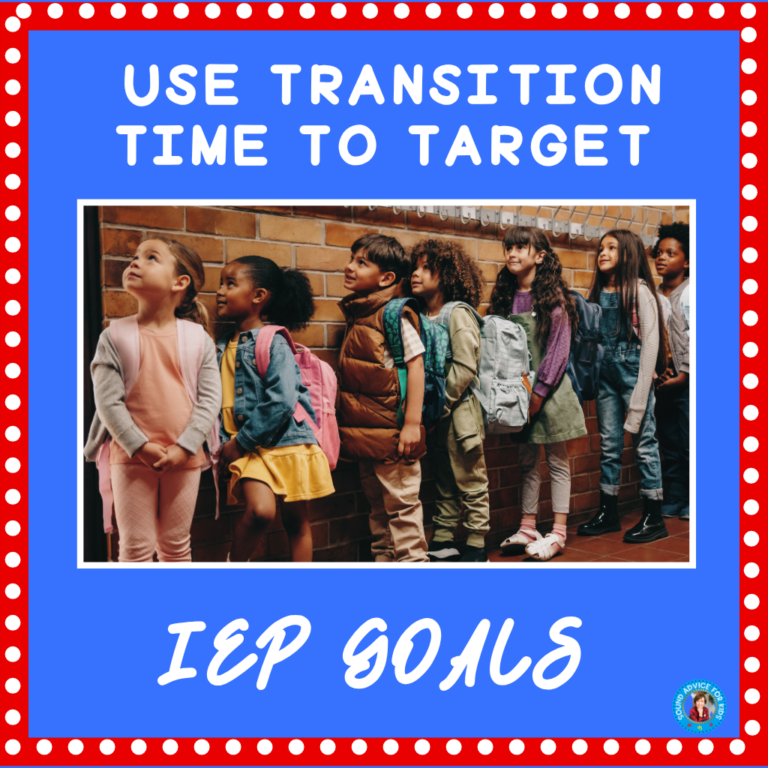


Let me ask you something. What’s happening in your classroom during the few minutes between activities? You know, preschool transition time, when kids are moving from snack time to free play? When you’re rotating small groups and waiting for everyone to settle?
If the honest answer is “surviving it” — I get it. For the first several years of my push-in career, transitions were just something to get through as fast as possible.
But here’s what I eventually figured out: preschool transition time during push-in therapy is some of the most underused therapy time in the entire preschool day. And once you start seeing it as an opportunity instead of an obstacle, you’ll pick up real, meaningful IEP practice multiple times every single session.
No extra materials. No extra planning. Just the natural flow of the school day — with a plan.
Why Preschool Transition Time Works So Well
In preschool, there are SO many transitions happening every day. You’ve got snack time rolling into free play. Free play rolling into reading books. Small group rotations where kids need to move to the next station. And every single one of those moments is an opportunity.
Over the years, I’ve landed on four IEP goal categories that fit almost perfectly into preschool transition time. These are my favorites — and if you watch my video below, I walk through each one with real examples from the classroom.
Goal #1: Following Directions
Preschool transition time is practically made for practicing following directions. Here’s one of my go-to strategies: right before kids move to their next activity or rotation, give each student a short direction sequence to complete first.
For example: “Tommy — clap your hands, stand up, and turn around.”
Once Tommy does it, the next student gets their turn. You can keep the direction the same for everyone (so kids can learn from each other) or switch it up for each student.
Here’s where it gets strategic. Think about the order you call on students:
- Students who will nail it go first — they become peer models for everyone watching.
- IEP students who are close to mastering the goal can go earlier — it’s a great chance to collect data in a generalized, natural setting.
- Students who need the most repetition go last — by the time it’s their turn, they’ve heard the direction four or five times. You’ve basically drilled it into their brains without them even realizing it!
One more idea I love: have the whole group say the direction out loud together before they do it. “Clap your hands, stand up, turn around.” Saying it together adds another layer of processing and helps get it into long-term memory.
Goal #2: Spatial Concepts
When it comes to spatial concepts, few moments beat preschool transition time — because the kids are literally positioned in space relative to each other. If you have students with push-in speech therapy goals targeting positional concepts, this is your moment. Use it!
Instead of just saying “okay, everyone line up,” try: “If you are sitting in back of someone, you can move on” or “If you’re sitting between Johnny and Bill, go ahead to the next station.”
You can also flip it and have students tell YOU where they are: “Johnny, where are you sitting?” Now he has to come up with an answer — “I’m between Marcus and Kate” or “I’m in front of the table” — and articulate a spatial concept in a completely natural, functional moment.
If you do this consistently throughout the year, the repetition is enormous. These concepts get solidified in ways that a worksheet or even a structured lesson just can’t replicate.
Goal #3: Wh Questions
Don’t overlook preschool transition time as a low-pressure moment to drop in some wh-question practice — the kids aren’t in the middle of an activity, so they actually have mental bandwidth to think and respond.

A few quick examples:
- Who: “Who has on a green shirt?” → Billy raises his hand or answers.
- Where: “Where is John right now?” → “He’s at the snack table.” “He’s on the rug.”
- What: “What is Timmy doing?” → “He’s sitting.” “He’s eating.”
These aren’t quiz questions — they’re genuinely functional, and you’re using the real classroom environment as the context. It doesn’t get more natural than that.
Goal #4: Phonemic Awareness
This one is my personal favorite, and the kids love it.
Instead of calling students by name during preschool transition time, make them figure out who gets to go next. Try:
- “Whose name starts with the /m/ sound?” → Marcia stands up and moves on.
- “Whose name ends with the /p/ sound?” → Philip gets to go.
- “I’m thinking of someone whose name rhymes with tally…” → The group calls out “Sally!” and she moves on.
Using kids’ own names makes phonemic awareness feel personal and exciting — not like a skill drill. And because you’re doing it during every transition, the repetition over weeks and months is powerful. Kids start recognizing rhymes, initial sounds, and ending sounds without it ever feeling like “work.”
The Bottom Line
You don’t need to add anything to your day to use these strategies. You just need to know what to look for and have a plan when the transition arrives. Pick one goal area next week. Try it during one transition. See what happens.
I promise you’re going to be surprised by how much IEP practice you can sneak into five minutes.
Learn More About Preschool Transition Time
I put together a short video walking through all four of these strategies — with real preschool examples and tips for being strategic about peer modeling. It’s quick and practical.
Want more ideas for making push-in speech therapy work in the preschool classroom? Join my email list for practical tips, strategies, and resources delivered straight to your inbox.
And if you’re ready for a deep dive, check out The Push-In Playbook — my step-by-step guide to making the most of every minute in the preschool classroom.


