

Let me be honest with you. When I first started as a preschool speech therapist, I had no idea what push-in vs pull-out speech therapy even meant. My very first assignment? Work right in the classroom alongside the teachers. No office. No quiet space. Just me, a roomful of preschoolers, and a whole lot of “figuring it out as I go.”
Grad school had not prepared me for this. At all.
I felt like I was swimming with sharks with no boat in sight. But over time — through plenty of trial and error — I discovered something surprising: working in the classroom wasn’t just manageable. It was actually better for my students. A lot better.
So if you’re weighing push-in vs pull-out speech therapy, or you’ve been asked to switch models and aren’t sure what to expect, let me break it down for you.
What’s the Difference?
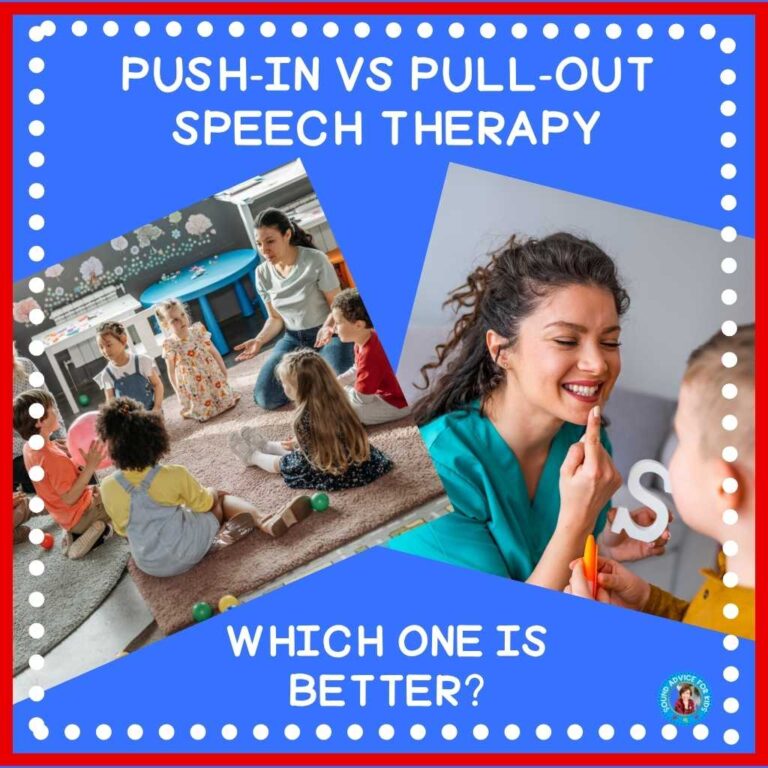
Pull-out therapy is the traditional model most of us learned about in grad school. You bring students to a separate space — usually your office — and work with them individually or in small groups. It’s quiet, controlled, and focused.
Push-in speech therapy flips that model on its head. Instead of pulling students out of the classroom, you go to them. You provide services right where they learn, play, and interact with their peers every day.
Sounds simple enough, right? But when it comes to push-in vs pull-out speech therapy, the two approaches are actually very different in practice — and they each have their place.
The Case for Pull-Out
Pull-out therapy has some real advantages, and I don’t want to dismiss them. When you’re working in a quiet, distraction-free space, you can:
- Introduce and practice new skills with focused, repeated trials
- Conduct evaluations and probes without classroom interruptions
- Work intensively with students who need a lot of individual attention

There are absolutely times when pulling a student out makes sense — especially when you’re teaching a brand new skill or gathering assessment data.
But here’s where the reality of preschool life complicates things. Pull-out therapy only delivers those benefits if you actually have a good space to pull students to. And that’s not always the case. Some SLPs don’t have an office at all. Others have one so far from the classroom that the walk alone eats up a significant chunk of the session. So what do you do instead? You improvise — and the options aren’t great:
- The hallway — technically pull-out, but hardly ideal. You’re sitting on the floor, there’s no surface for materials, and other students and staff are constantly walking by. Try getting a preschooler to focus in that environment!
- Pulling aside within the classroom — the student is still in the room, surrounded by noise, peers playing nearby, and every distraction imaginable. Your carefully chosen therapy materials are competing with blocks, dress-up clothes, and a very exciting sensory table.
These workarounds are understandable — sometimes they’re the only option — but they cancel out most of the advantages listed above. You’ve lost the quiet and focus of a true pull-out setting without gaining any of the benefits of genuine push-in speech therapy. It’s the worst of both worlds.
That’s one of the many reasons I came to believe that in the push-in vs pull-out speech therapy debate, true push-in — working with the class, not just in the room — is almost always the better approach, especially when the alternative looks like one of the scenarios above.
The Case for Push-In Speech Therapy
Here’s where things get interesting. Once I got comfortable in the classroom, I started to see what push-in vs pull-out speech therapy really looked like when push-in was done well — and what it could do that pull-out simply couldn’t.

When you’re working in the classroom, you can:
- Watch your students interact with their peers in real time — which tells you so much more than a controlled session ever could
- Target generalization of skills in the natural environment where students actually need to use them
- Leverage peer models — typically developing students are incredibly powerful teachers
- Coach classroom staff in the moment, so your strategies don’t stop when you leave
- Serve more students in less time by working with groups during circle time, snack, or free play
- Provide less restrictive services — which is not only best practice, it’s what IDEA encourages
That last point is worth sitting with for a moment. Pull-out therapy, by definition, removes a student from their natural learning environment. Push-in keeps them connected to their class, their routine, and their peers — all while getting the support they need.
Push-In vs Pull-Out Speech Therapy: So Which One Is Better?
Here’s my honest answer to the push-in vs pull-out speech therapy question: it depends — but push-in is usually the better long-term model for preschoolers, especially when you can collaborate with the classroom teacher.
The magic really happens when you and the teacher work as a team. You plan together, you co-teach, you divide and conquer. The teacher learns your strategies. You learn the curriculum. And your students get speech and language support woven into the fabric of their school day — not just tucked into a 20-minute pull-out session twice a week.
That said, push-in vs pull-out speech therapy is rarely a simple either/or decision — push-in isn’t always easy to implement, especially if you’re new to it or working with a teacher who isn’t on board yet. It takes time, trust, and a whole lot of flexibility.
I know because I’ve been there.
Ready to Make Push-In Work for You?
After 30 years as a preschool push-in speech therapist, I’ve learned what works, what doesn’t, and how to make the most of every minute in the classroom. And I want to share all of it with you.
Join my email list to get practical tips, strategies, and resources delivered straight to your inbox — everything you need to feel confident and effective as a push-in SLP.
Already feeling curious about push-in speech therapy but don’t know how to get started? Check out The Push-in Playbook: Speech Therapy in the Preschool Classroom on Teachers Pay Teachers for a deep dive into goals, data tracking, co-teaching strategies, and so much more.